Updated Feb 20, 2026
Probabilistic Stock Volatility Forecasting
Built a machine learning pipeline to forecast 5-day stock volatility using historical market data.
- - Improved forecast accuracy by 23–28% compared to simple baseline methods across SPY, QQQ, and AAPL.
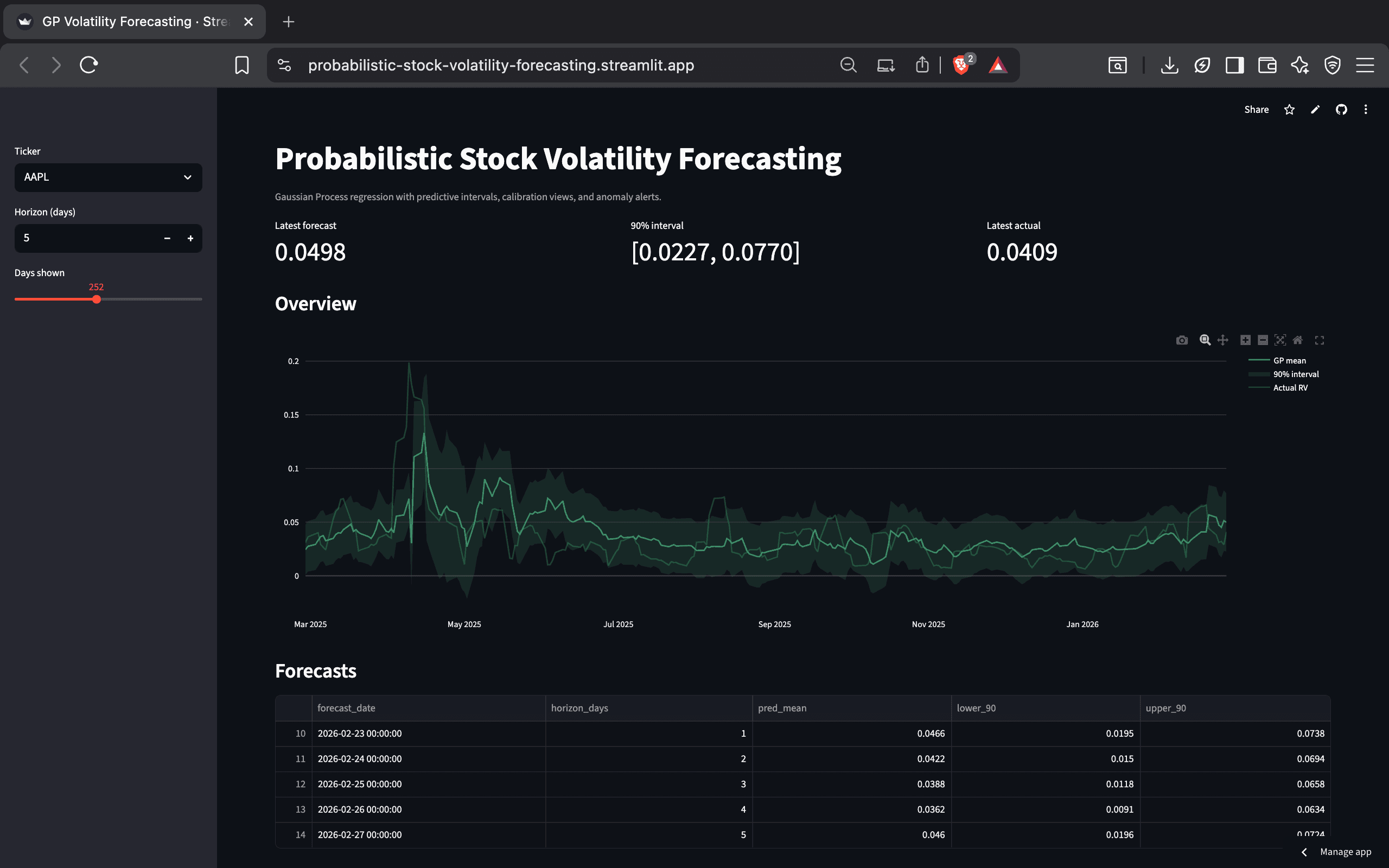
- - Shipped a Streamlit dashboard for visualizing forecasts, uncertainty bands, and model performance.
Problem
The project forecasts 5-day-ahead realized volatility for SPY, QQQ, and AAPL while quantifying uncertainty for monitoring and decision support.
Approach
- - Downloaded daily OHLCV data from yfinance and cached it locally.
- - Engineered realized-volatility features including RV lags, return statistics, calendar cyclic features, and volume z-scores.
- - Trained rolling-window exact Gaussian Processes with PyTorch and GPyTorch.
- - Generated 50%, 90%, and 95% prediction intervals and surfaced anomaly/regime alerts in a Streamlit dashboard.
Results
- - The GP model outperformed persistence and EWMA baselines across all three tickers in the latest walk-forward snapshot.
- - The dashboard provides both point forecasts and interval bands so forecast confidence is visible.
- - Artifacts are versioned so deployment does not require retraining on startup.
Technical Evaluation
| Ticker | RMSE | Baseline RMSE | RMSE Reduction | MAE | Baseline MAE | MAE Reduction | 90% Coverage | Avg 90% Width |
|---|---|---|---|---|---|---|---|---|
| SPY | 0.0103 | 0.0140 | 26.5% | 0.0062 | 0.0083 | 25.1% | 0.9801 | 0.0439 |
| QQQ | 0.0117 | 0.0163 | 27.8% | 0.0081 | 0.0105 | 23.2% | 0.9682 | 0.0450 |
| AAPL | 0.0198 | 0.0258 | 23.2% | 0.0133 | 0.0175 | 23.8% | 0.8986 | 0.0527 |
Average reduction across SPY/QQQ/AAPL: RMSE 25.8%· MAE 24.0%.
Tradeoffs
- - Exact GP training with rolling windows increases runtime and tuning cost.
- - Committed artifacts simplify deployment but require periodic refresh to stay current with new market data.